rods, reels and lines


Nov 11
2010

Streamer fishing for Michigan steelhead- gearing up

Over the next few weeks, Kevin will be putting together a series on his method for catching Michigan steelhead on streamers. Kevin isn’t saying he’s the grandmaster ninja of steelhead streamering, but over the years he has developed a straightforward and efficient method that puts chrome in the net. The series will include: gearing up, streamer patterns, reading water with a thermometer and calendar, reading water and finding patterns, presentation styles, fishing basics, and ways to make sure you’re getting the job done.

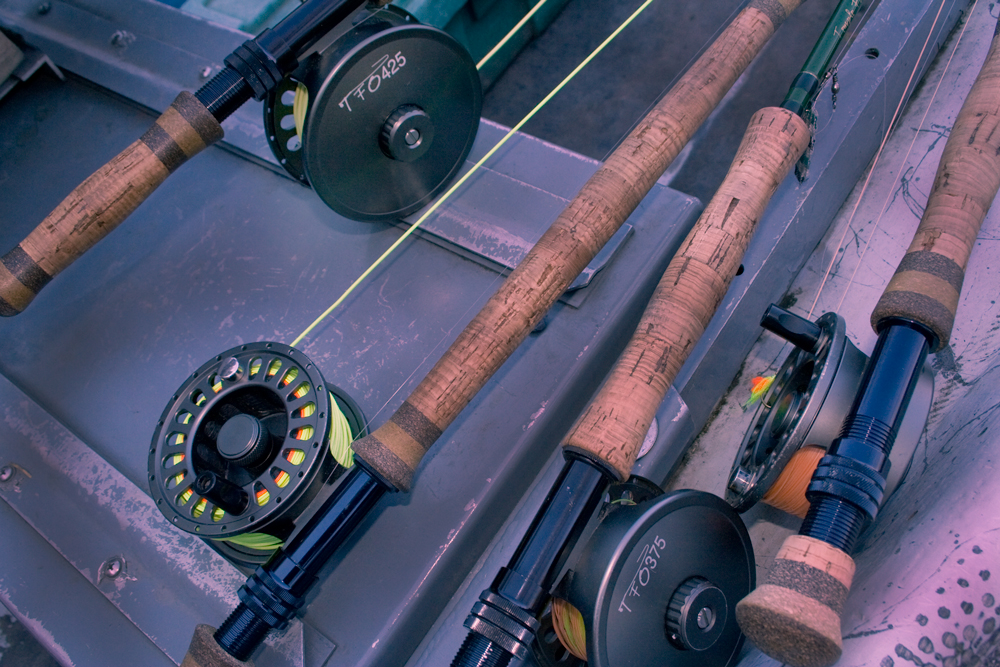
Rod- Temple Fork Outfitters 13′0″ 7/8 weight, 450-700 gr. Of course you can effectively streamer fish with a single-hand rod, but it is a lot more work and not as effective in many situations. I use this relatively big rod because it has no limits as far as the west Michigan rivers I fish are concerned. I can cast a large fly the distance I need to with enough weight to get the job done, I never have to compromise because I’m never “under gunned”.

Reel – Temple Fork Outfitters LA425. I own a dozen reels of different sizes in this series. I have owned them for years. I never service them. I have never had one repaired and they are all still working and working well. They have plenty of drag to handle even the hottest fish and because the drag surface is synthetic/stainless they don’t freeze up in winter.

Backing- 20lb Dacron.

Running/Shooting Line- I’ve used a lot of different running lines over the years and while it’s not the most important part of the rig for me, a coated running line like Rio’s Powerflex will result in fewer tangles than something like Amnesia.

Fly Line- Scientific Anglers Mastery Series Spey Skagit Deluxe 550 gr.

Sink Tip – 12 to 24 foot of Rio T14. In the lower Pere Marquette I have been using an eighteen foot section this entire season. I like the Rio T line of sink tips for many reasons, but particularly because you can tie a knot in them. I end the T14 with a 4 wrap uni-knot tied to a large two-way swivel.

Leader – 3 to 4 foot of 20 pound Maxima fluorocarbon. Tied to the large two-way swivel with an improved clinch knot. This section of leader ends with another medium sized two-way swivel. I feel that knots to swivels are faster and more secure than line to line knots and I like having the swivels to eliminate line twist.

Tippet – 2 to 3 foot of 12 pound Feather-Craft fluorocarbon. For all my tube flies I have tippet sections pre-snelled on my favorite hook and keep them in a leader keeper. For streamers on traditional hooks I simply add a few feet of the same tippet material to the second swivel.

Hook – Gamakatsu octopus 02408 in size 4. This is the finest tube fly hook I have found for Michigan steelhead.

Stay tuned for Part 2 of Kevin’s series: streamer patterns.


Sep 06
2010

Pere Marquette fishing report- Sept 5th

There are decent numbers of salmon in the Pere Marquette River. There are also a lot of anglers and fishing can be tough because of it. This week should see an easing of pressure and more fish continuing to enter the system and move up. We’re seeing some worked up gravel already in the middle river and even spotting a couple fish that haven’t been raked off their nests yet. Remember, the more fish you release, the more fish there will be for the future. The Pere Marquette’s salmon fishery is 100% wild. If you’d like to harvest a fish, please think about harvesting small males only.

Flows just peaked last night a bit over 600cfs at Scottville which means fish should continue to move for a few days. Thundersticks are by far the best bet for getting a fish’s attention, however we’ve been working with a couple different streamer patterns that provide lateral line stimulation in a way similar to Thundersticks. Steve has been hard at work dialing in a foam bodied wiggle minnow pattern that definitely throws out a lot of vibration. These patterns also seem to bring out the aggressive side of even the smallest brown trout. Swinging streamers for fresh, early kings is not the most productive way to fish for them, but with these kinds of flies we have been able to stick a few fish with the two handed rod. A long, heavy sink tip is necessary to get these flies down into the fish’s zone. Our standard early king spey set up is an 8/9 weight 12-14′ rod, 550-650 grain skagit head, and 10-12′ of T14 or T17. More on rigging and fishing this setup later in the week.

There really isn’t anything more rewarding than swinging up a fresh, 15lb king salmon on the two hander.


Aug 16
2010

50s Fly Casting

Kevin, Indigo’s idea man, was wondering the other day how fast flies fly.  After much internet searching we’re only slightly closer to answering that question.  But one of the bonus fruits of all our searching labor is this video from 1956.  No offense Cam, but one  of the things that date this video is the floppy fiberglass rod.  But other than that, the casting stroke, double hauls, etc. are all quite modern.  Pretty cool to see the continuity between modern fly casting and 1950s fly casting. Now if we could just find a video from 1880.

Stay tuned tomorrow for some salmon pump up.  Those big fish are just around the corner.  Never a dull moment here on the Third Coast.


May 13
2010

the rod, reel and line that changed Kevin’s fishing life

Wow. Strong words. They are true though. I have been at Kevin’s altar, hearing him preach the good word about two-handed, overhead casting in open water, bombing accurate 80 foot casts all day every day for ten days in a row with no fatigue. Why depend on muscle when you can use mechanical advantage? Here me now!

On a ten day trip last year to Quetico Provincial Park in Canada, after fishing hard each day from sun-up to sun-down, the only thing that started to ache were the muscles used for stripping line. Other folks on the trip didn’t fair as well having to launch big streamers with their single-handers.

The TFO TiCr X 9′ 8wt with the two handed conversion kit is a long casting machine. Awesome for smallmouth, pike, steelhead and salmon in the surf, carp, wiper, striper, bluefish, pretty much anything where you have to make long casts into the wind over and over and over again. At 11′ 3″ long, paired with a Scientific Angler’s Mastery 360gr Skagit head, this rod is incredible. And TFO’s 375 Large Arbor reel is bombproof. Kevin has a dozen 375s that are in constant guide use and they are still going strong. Put a heavier Skagit head on the rod and you’re knocking out spey casts, swinging streamers for steelhead on the river. Take the conversion kit off and you’ve got one of the best 9′ 8wts on the market at your disposal.

Stay tuned for the raffle results.

Check out some of the fish Kevin has caught on this setup over the last year or so. I love that first picture.  Click on all of them to enlarge.


Big thanks to TFO and SA who were very generous in donating to our cause.